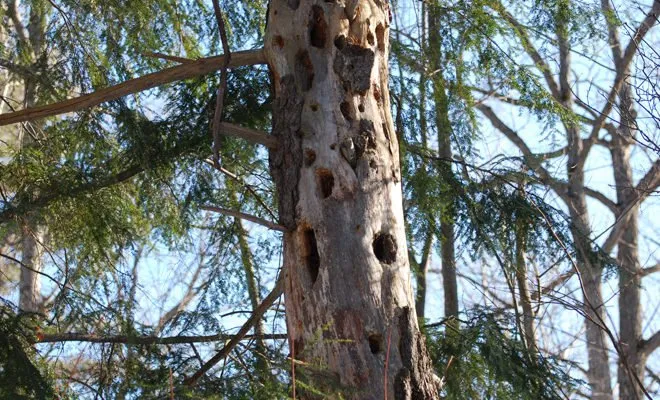
A dying tree rarely falls without warning, but the warning signs are easy to miss until it is too late. Learning the signs of a dying tree can help you protect your family, your home, and your neighbors, especially in Northeast Florida where mature oaks and pines tower over homes and hurricanes test every weak limb. This guide is written for Jacksonville homeowners who want to know how to tell if a tree is dying, what those symptoms mean, and when to call a certified arborist. Drawing on 35-plus years of local tree care, we will cover the eight warning signs that matter most and the practical tests you can do from the ground.
Key Takeaways
- The clearest signs of a dying tree include bare branches during the growing season, fungal growth, bark loss, and large amounts of deadwood.
- A simple scratch test and branch snap test can reveal whether a tree or limb is still alive.
- Leaning, cracks, and root damage are structural red flags that can make a tree hazardous even before it fully dies.
- Roughly 1 in 4 tree failures trace back to root or trunk decay that was hidden below ground.
- When you see multiple warning signs, get a professional assessment before the next storm season.
Why Spotting a Dying Tree Early Matters in Northeast Florida
Jacksonville’s tree canopy is one of its greatest assets, but a declining tree in a storm-prone region is a serious liability. A dead or dying tree loses the flexibility that lets healthy wood bend in high wind. When Atlantic hurricane season arrives on June 1, weak and decayed trees are the first to fail.
The stakes are real. The University of Florida IFAS Extension notes that tree failures during storms cause significant property damage and injury every year across the state, and many of those trees showed detectable defects beforehand. Catching problems early gives you options: targeted pruning, cabling, or planned removal on your schedule rather than an emergency call at 2 a.m.
The 8 Warning Signs of a Dying Tree
1. Bare branches or no leaves during the growing season
In our climate, most hardwoods should be fully leafed out from spring through fall. If a section of the canopy stays bare while the rest of the tree, and neighboring trees, are full, that dead zone is a strong signal of decline. Watch especially for the top of the tree thinning out, known as crown dieback, which often points to root problems.
2. Brittle bark, cracks, or bark falling off
Healthy bark stays firmly attached and renews itself. When bark loosens, cracks vertically, or falls away to expose smooth, dead wood underneath, the tissue below has stopped growing. Deep vertical cracks in the trunk are especially concerning because they can indicate internal splitting.
3. Fungus, mushrooms, or conks on the trunk or roots
Mushrooms and shelf-like growths (conks) at the base of a tree or on the trunk are one of the most reliable signs of internal decay. Fungi feed on dead wood, so their presence usually means the wood inside is already rotting. Because our humid climate favors fungal growth, this is a common and important warning sign in Jacksonville.
4. Excessive deadwood in the canopy
A few dead twigs are normal. Large dead limbs, or many of them, are not. Deadwood over 2 inches in diameter is both a sign of decline and an immediate falling hazard. If you are seeing repeated limb drop with no storm to blame, the tree is telling you something.
5. A sudden or worsening lean
Trees can grow at an angle naturally, but a new lean, or one that is increasing, often means the root system is failing. Look for soil that is cracked, heaved, or mounded on the side opposite the lean. That is a sign the root plate is lifting, which can precede a full uproot.
6. Soft, hollow, or crumbling wood
Tap the trunk with a mallet. A healthy trunk sounds solid; a hollow or dull thud can indicate internal decay. Wood that crumbles when you press it, or visible cavities, means the structural core is compromised even if the outside still looks alive.
7. Root damage or soil disturbance
Roots are the anchor, and they are usually the hidden culprit. Recent construction, trenching, driveway work, or soil compaction near a tree can sever roots and start a slow decline that shows up in the canopy a year or two later. Girdling roots that wrap around the trunk base are another quiet killer.
8. Pest infestation
Sawdust-like frass, exit holes in the bark, or peeling bark with insect galleries underneath point to boring insects. Pests often attack trees that are already stressed, so an infestation is frequently a symptom of a deeper decline rather than the sole cause.
Two Simple Tests You Can Do From the Ground
You do not need special tools to gather early evidence.
The scratch test
Use a fingernail or pocketknife to gently scratch a small spot on a twig or the bark. Living tissue (the cambium) is green and moist just under the surface. If it is brown and dry, that branch, or that part of the tree, is dead. Test several branches in different areas to map how much of the tree is still alive.
The branch snap test
Bend a small twig. A living branch is flexible and bends before it breaks, showing green inside. A dead branch is brittle and snaps cleanly with no green tissue. If most branches you test snap dry, the tree is likely in serious decline.
Sick Versus Dying: Know the Difference
Not every struggling tree is beyond saving. Many trees that look sick can recover with the right care. Our guide to the early, often-treatable symptoms of a sick tree covers what usually can be turned around.
| Symptom | Often treatable | Likely serious |
|---|---|---|
| Yellowing or early leaf drop | Yes, may be nutrient or water issue | If widespread and worsening |
| A few dead twigs | Yes, prune and monitor | If large limbs are dying back |
| Small trunk wound | Yes, with proper care | If accompanied by conks or hollow sound |
| New or increasing lean | Rarely | Yes, often root failure |
| Mushrooms at the base | No | Yes, internal decay |
A certified arborist can often diagnose the difference and, when possible, recommend pruning, soil care, or cabling instead of removal. When the tree is too far gone, planned tree removal protects everything around it.
When to Call a Professional Right Away
Some situations should not wait. Contact a professional immediately if you see:
- A new lean with soil cracking or lifting at the base.
- Large cracks in the trunk or at major branch unions.
- Conks or mushrooms on the trunk combined with a hollow sound.
- Dead or hanging limbs over a house, driveway, or power line.
- Any of these on a large tree before hurricane season.
The International Society of Arboriculture recommends that hazard trees near targets like homes and walkways be evaluated by a qualified arborist, who can assess defects that are not obvious from the ground. If a tree has already dropped a limb or is threatening a structure, our emergency tree services team is available around the clock across Jacksonville.
FAQ
How can I tell if a tree is dying or just dormant?
Use the scratch test: gently scrape the bark on several branches. Green, moist tissue underneath means living wood, while brown, dry tissue means that section is dead. If most branches test brown and stay bare during the growing season, the tree is likely dying rather than dormant.
Can a dying tree be saved?
Sometimes. Trees showing early stress like yellowing leaves, minor deadwood, or a treatable pest issue can often recover with pruning, soil care, and proper watering. Trees with root failure, internal decay, or a spreading lean usually cannot be saved and should be assessed for removal.
Are mushrooms on a tree a bad sign?
Yes. Mushrooms or shelf-like conks on the trunk or roots typically indicate internal wood decay, since these fungi feed on dead wood. Even if the canopy still looks healthy, fungal growth means the structural wood inside may be compromised and warrants a professional inspection.
Is a leaning tree always dangerous?
Not always. A tree that has grown at an angle its whole life is often stable. A danger sign is a new or increasing lean, especially with cracked or heaved soil at the base, which suggests the roots are failing. That type of lean should be evaluated right away.
How often should trees be inspected in Jacksonville?
Have large trees near your home inspected at least once a year, ideally before hurricane season begins June 1. Inspect more often after major storms or nearby construction, both of which can cause hidden root and structural damage that leads to decline.
Do Not Wait for a Tree to Fall
The signs of a dying tree, from bare branches and fungal conks to new leans and hollow wood, are your early warning system. In a hurricane-prone region like Jacksonville, spotting these red flags early lets you act on your terms instead of during an emergency. If you have noticed even one or two of these symptoms on a large tree near your home, it is worth a professional look before the next storm.
Custom Tree Surgeons has spent more than 40 years diagnosing and treating declining trees across Northeast Florida. Call (904) 944-9954 or request a free tree care estimate for a certified-arborist assessment of any tree you are worried about.